The rings keep growing — and every one persists. Each card below catalogs a body of work shaped by more than one growth ring — the roles, the decisions, the deliverables, the outcomes. This is not a portfolio. These are points in time where my accumulated aptitude converged on a specific challenge or creative pursuit.
Motion DesignVisual CommunicationInteractive Media
Multimedia & Motion Design: An Era
Multiple Clients · 1998–2008
Before eLearning had a name. Before the tools were forgiving. A decade of print, motion, and interactive work that built the visual instincts everything after it depended on.
Coming soon
Web DevelopmentUI/UX DesignSystems Architecture
Web Application Design & Development
Enterprise Clients · 2005–2015
The decade when the artist learned to engineer. Design systems, application architecture, and the slow realization that the most elegant UX decisions are invisible to the people they serve.
Coming soon
Clifton Strengths — All 34, per Gallup
How I’m wired
Executing
4Achiever
9Consistency
10Focus
14Responsibility
20Restorative
22Belief
25Arranger
26Discipline
27Deliberative
Influencing
2Communication
8Significance
15Woo
16Competition
17Maximizer
21Self-Assurance
29Activator
30Command
Relationship Building
1Adaptability
3Empathy
5Harmony
6Includer
7Positivity
13Relator
18Developer
19Connectedness
34Individualization
Strategic Thinking
11Strategic
12Learner
23Context
24Futuristic
28Ideation
31Input
32Analytical
33Intellection
Case Study
Digital Learning Transformation & Adoption
A platform migration that couldn't pause for confidence to catch up.
Charles Schwab Advisor Services · 2018–2021
About this exhibit
Depth of Detail
The narrative and content exhibited here represent just a portion of the completed work — intended to provide an overview of the initiative's scope and approach.
What's in a Name
Like all evolving technology initiatives, Marketing evolved the name and brand frequently. Several variations may appear throughout the content exhibits on this page.
Exhibited Content
Exhibits are second-generation. Corporate branding has been obscured. Any information displayed is immaterial. Original quality exceeded what's shown here.
01The Problem
You build a practice inside a platform over years. Every workflow path becomes reflexive — client accounts, transaction records, reporting structures — until the software stops being software and becomes the medium through which you serve people, maintain fiduciary obligation, run a business. Then the platform changes — not as a feature update, but as a reorganization of how an advisory practice operates. And what was second nature becomes friction, and friction at that scale becomes something closer to crisis.
These were experienced financial advisors, not technology resisters. They knew how to learn. What they didn't have was a support architecture designed to carry them through transformation while still functioning at the level their clients required.
The phrase that surfaced in early discovery was direct: dropped off a cliff.The transition wasn't waiting for their confidence to catch up. That gap is where this project began.
02The Scope
Fifteen hundred RIA firms annually. Each one an independent advisory practice with its own staff, its own workflows, and its own clients who expected continuity regardless of what was happening on the platform side.
The scope wasn't defined by the number of firms. It was defined by what each firm needed to do while it was happening — keep serving clients, maintain compliance, move money, manage accounts — inside a system they were still learning, on a timeline that didn't pause for their confidence to catch up. Digital transformation at that scale isn't a rollout. It's a sustained operational condition.
Three years. Thirteen months of that to go from discovery to launch — identifying the problem, scoping the architecture, and getting the first firms through. The rest was iteration: refining the UX, tightening the content, hardening what the data confirmed worked. Five simultaneous roles. One through-line: the firms on the other side of this transition had to arrive there functional, not just trained.
Technical Program Director
Strategically planned and implemented the Cornerstone OnDemand LMS, integrating supporting HRIS systems with an eye on scalability and seamless integration.
Innovation & Content Strategy Lead
Crafted a dual-channel learning strategy merging micro-learning with multimedia resources, enhancing engagement and flexibility for learners.
Technical & UX Architect
Built and launched a user-centric learning environment, prioritizing accessibility and user satisfaction through intuitive digital interfaces. WCAG 2.1 AA compliance throughout.
Multimedia Production Director
Directed the production of multimedia learning materials and personally executed content creation across the full production stack — blending strategic oversight with direct, hands-on development and deployment.
Team Development Coordinator
Led professional growth and team efficiency initiatives, fostering a culture of continuous improvement and strategic mentorship.
Content Exhibit
Socializing the Strategy
Before the first micro-learning module was built, the strategy itself needed an audience. This video was produced to communicate the learner engagement approach to a broad range of stakeholders and business partners — an in-house production whose quality, as much as its content, made the case that professional digital video lived within the team's capability. Producing it was proof of concept.
My Role
Storyboarding
Audio/soundtrack production
Motion graphic sequences
Video composition and editing
Encoding and deployment
Tools
Adobe Audition
Adobe Photoshop · Illustrator
Adobe After Effects
Adobe Premiere Pro
Adobe Media Encoder
Accessibility
Interactive transcript, PDF-based transcript, and closed captioning originally provided through video hosting platform.
03The Learner
The persona work started with a question that most platform migrations don't ask: what does this person's day actually look like, and where does the new system interrupt it?
The RIA advisor wasn't a technology resister. They were a relationship professional whose credibility with clients depended on operational fluency — the ability to execute requests accurately, quickly, and without visible friction. A fumbled account transfer or a delayed document submission wasn't a minor inconvenience. It was a trust event.
Advisor Firm Principals
Leads digital learning initiatives for the firm
Ensures access to tailored resources
Aims to improve operational efficiency and client satisfaction
Advisor Firm Staff
Embraces digital platforms for skill enhancement
Committed to continuous learning and adaptation
Improves efficiency and client service through digital transformation
Operations Support
Focuses on streamlining operations through digital learning
Advocates for continuous improvement
Dedicated to adopting innovative processes for efficiency
What the persona work surfaced, and what shaped every content and delivery decision that followed: the advisors weren't asking to be trained. They were asking to stop feeling lost. Those are different problems, and they require different solutions.
04The System
The Premise
Holistic Learning Ecosystem
The solution wasn't a training program. It was a learning ecosystem — designed from the learner outward, not from the platform inward. A comprehensive environment enriched with multimedia resources, delivered across two channels, and built to meet each learner at the moment of need — whatever that moment looked like for them.
Channel 1
Self-Directed Learning Pathways
A curated library inside the LMS: micro-learning modules mapped to specific workflow functions, sequenced to match adoption milestones, and built short enough to fit inside the actual workday of an advisory practice. Not courses. Capabilities — each one addressable at the moment of need.
Role-Tailored
Specific to individual job functions
Enhances skills and career progression
Focuses on essential knowledge per position
Supports individual and organizational growth
Self-Select / On-Demand
Learners choose their own courses and materials
Supports individualized schedules and styles
Enables knowledge pursuit at one's own pace
Adaptive Learning
Personalizes experience by performance and behavior
Adjusts content, pace, and pathway individually
Utilizes adaptive learning technologies
Instructional Videos
Short instructional videos — like this one showing advisors how to customize client account views — simplified complex concepts for quick learning, boosting retention and immediate application in the actual workflow.
My Role
Storyboarding
Audio/soundtrack production
Motion graphic sequences
Video composition and editing
Encoding and deployment
Tools
Adobe Audition
Adobe Photoshop · Illustrator
Adobe After Effects
Adobe Premiere Pro
Adobe Media Encoder
Accessibility
Interactive transcript, PDF-based transcript, and closed captioning originally provided through video hosting platform.
Digital Job Aids
Concise, on-the-spot guidance available exactly when and where it's needed — enabling continuous learning and immediate application of new knowledge in daily tasks.
Content logically ordered. Alt text for images. Minimum color contrast ratios for text. Screen reader compliant.
Channel 2
Blended Learning Experiences
The second channel was live. Transition Managers facilitated guided sessions with firm leadership using the platform itself as the demonstration surface — not slides, not simulations, but the actual operating environment. A knowledge management framework organized content for self-guided reinforcement while instructor-led sessions added interactive depth. The two tracks reinforced each other in sequence: facilitated sessions created orientation; the micro-learning library gave that orientation somewhere to go.
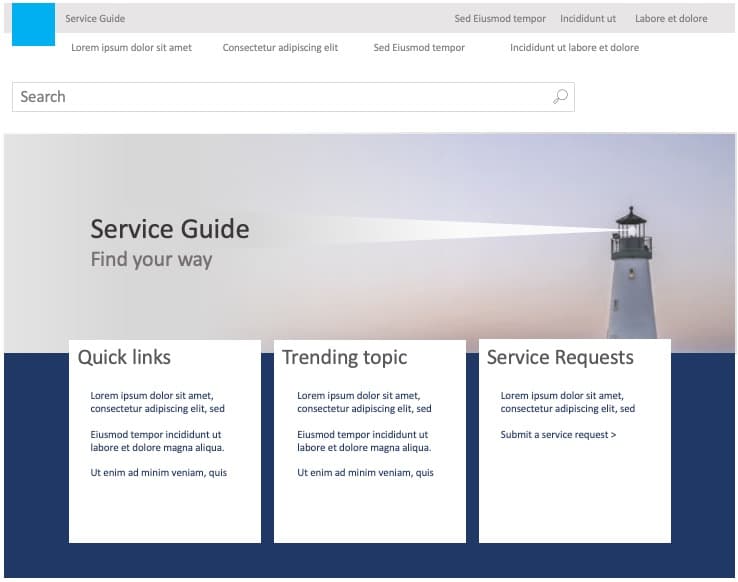
Service Guide — A knowledge management framework centralizes educational content, enabling efficient, personalized access at any scale.
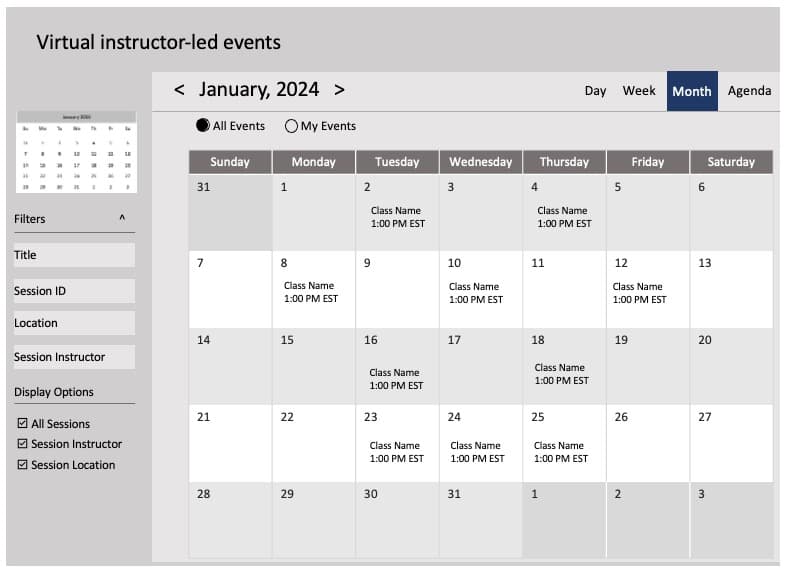
ILT Calendar — Instructor-led sessions provide expert guidance and structured learning, transforming abstract concepts into practical applications.
05The Evidence
The firms arrived functional.
50%
LMS Adoption Lift
30%
Platform Adoption Lift
25%
Navigation Time Reduction
These numbers matter because of what they're measuring. LMS adoption is a proxy for whether people trusted the learning environment enough to return to it. Platform adoption is a proxy for whether the transition actually took. Navigation time is a proxy for whether the design put users where they needed to be. All three moved in the right direction because the architecture addressed the right problem — not how to deliver training, but how to restore operational fluency under conditions that were actively disrupting it.
The work took three years. The outcomes held.
Assessment & Communication
Quarterly Evaluation
Measurement wasn't the endpoint — communication was. This video demonstrates how the team used generative AI to socialize the effectiveness of the learning strategy with a broad-based audience across digital channels on a quarterly basis. The outcome data mattered. The ability to transmit that story at scale mattered equally.
My Role
Generative AI storyboarding
Audio/soundtrack production
Graphic asset generation
Tools
Adobe Audition
Adobe Photoshop · Illustrator
Lumen5
Accessibility
Interactive transcript, PDF-based transcript, and closed captioning originally provided through video hosting platform.
06The Craft
Every asset was built in-house. The visual language was designed to feel native to the platform environment rather than imported from a generic instructional design template — because learners who perceive a gap between their training materials and their actual tools are being told, implicitly, that the two worlds don't fully connect. That gap has a cost.
The craft was in service of the confidence. That was always the point.
UX/UI Design
Customizing the User Experience
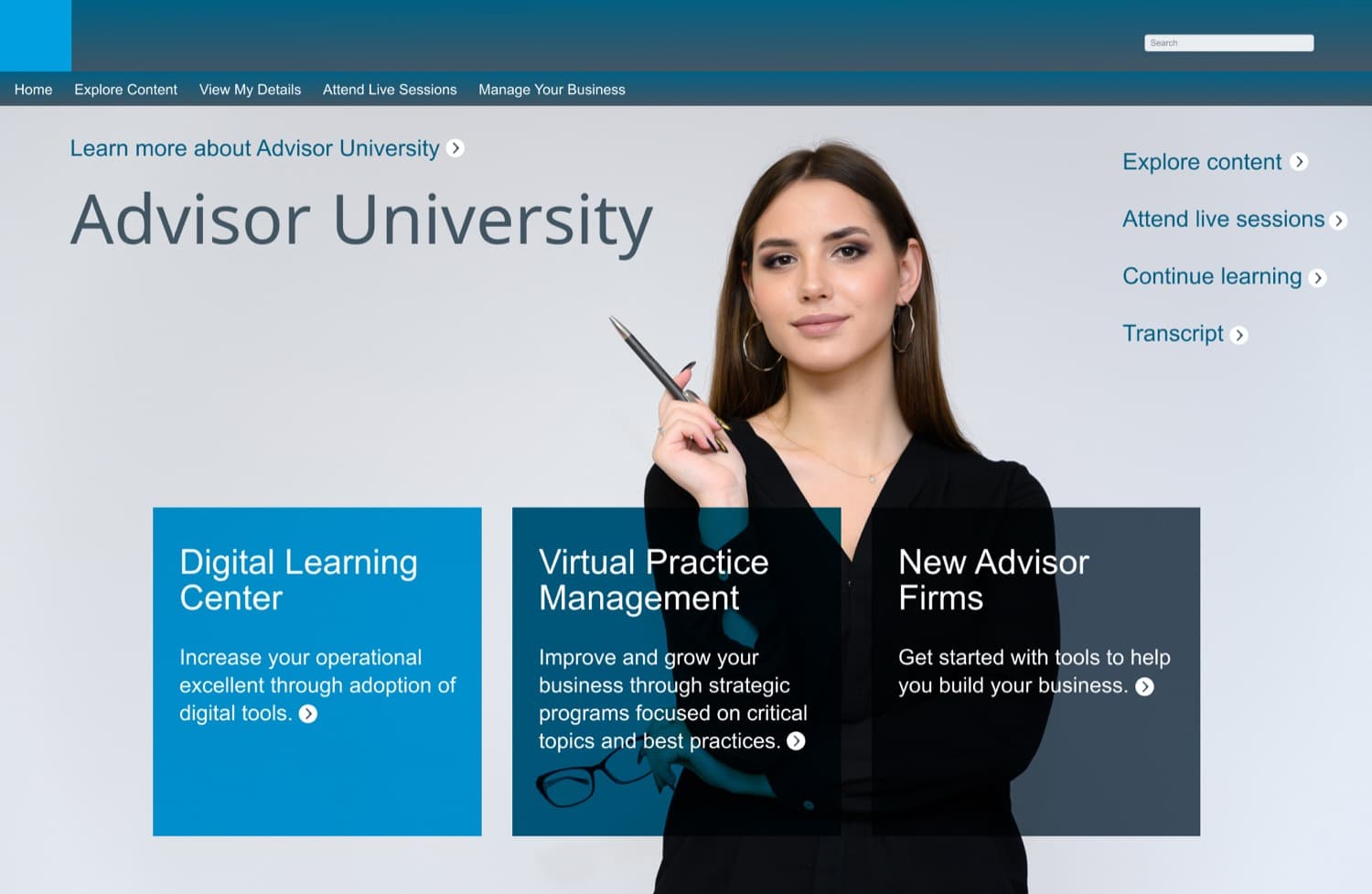
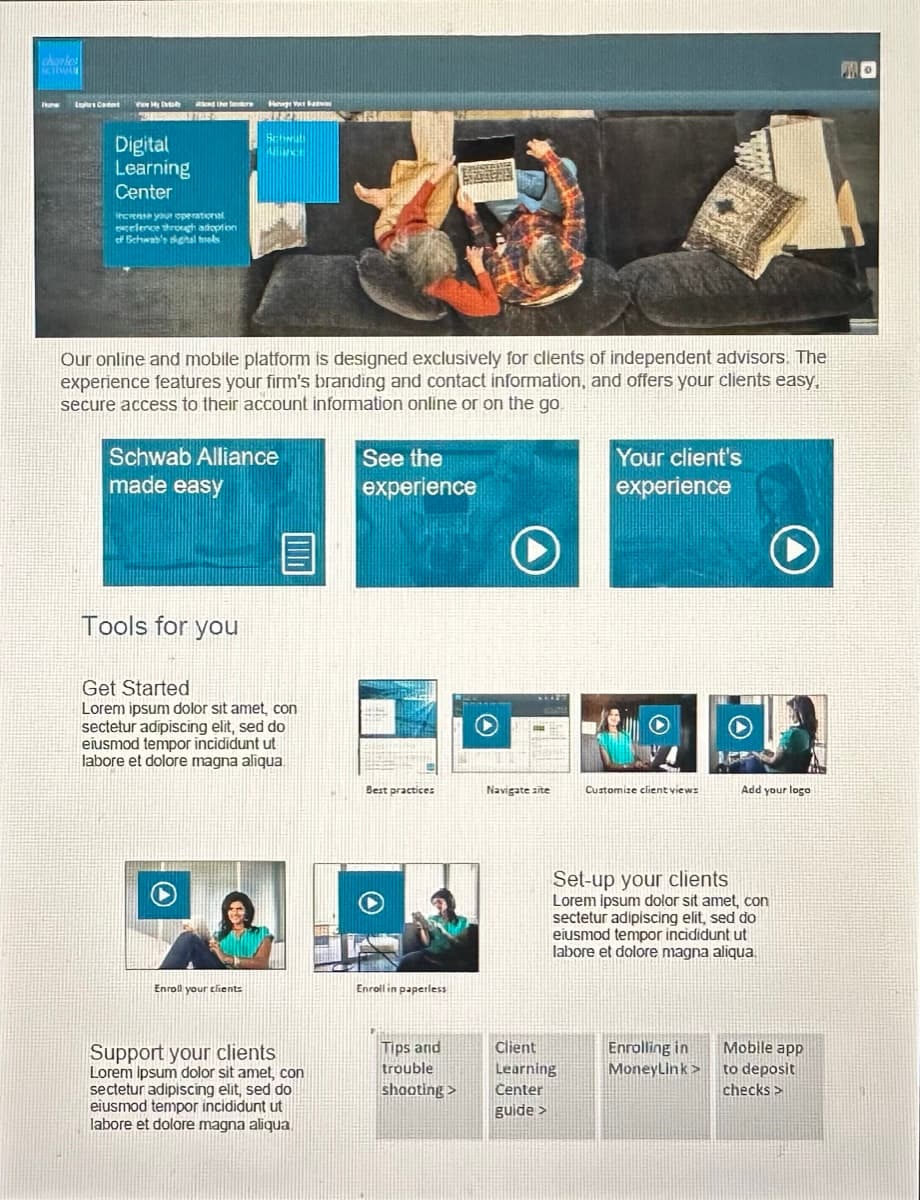
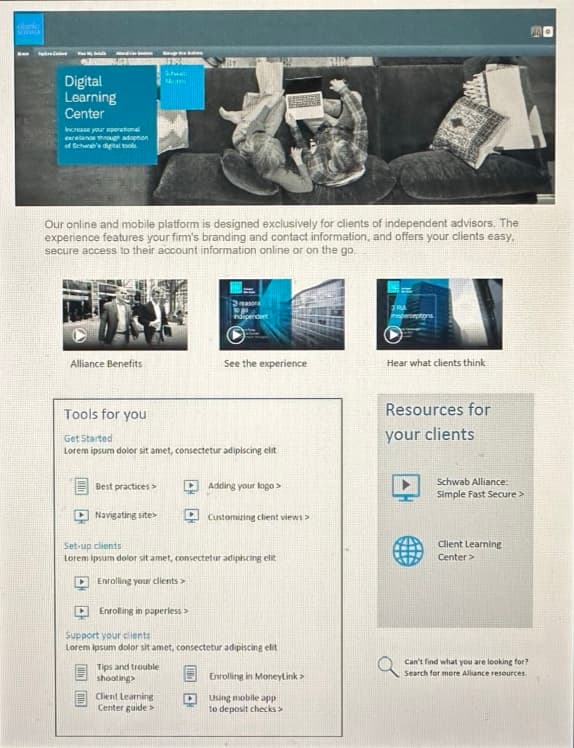
Empathy at the core of the UX strategy provided a bridge to learners — giving them confidence and competence in navigating the new digital landscape. Clear, purposeful, empathetic UI. Every interface decision answered a single question: what does this person need to accomplish right now, and how do we remove every obstacle between them and that outcome.
Advisor University Home Page
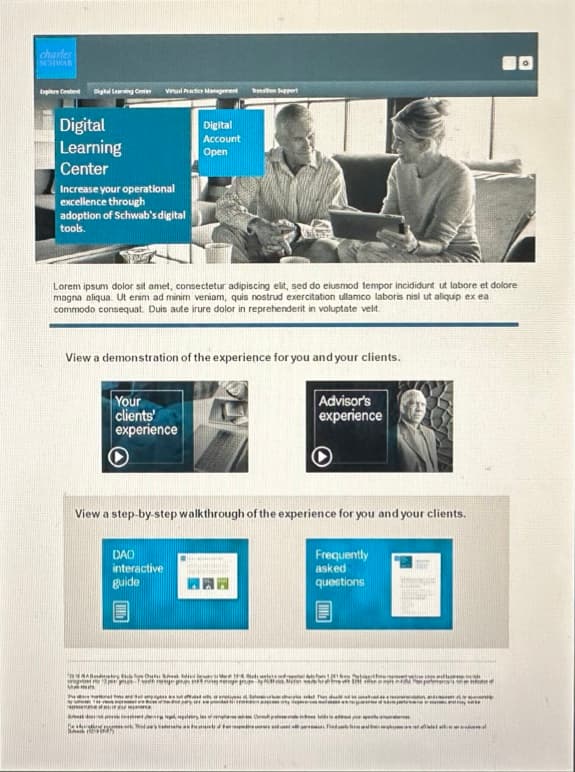
Learning Strategy — View 1
Learning Strategy — View 2
Learning Strategy — View 3
My Role
Product design
Front-end development
Technical implementation
Tools
Figma
Adobe Photoshop · Illustrator
Adobe Dreamweaver
LAMP Web Architecture (sandbox)
Approach
Designed an intuitive, user-centric interface directly addressing the concern of feeling unsupported during platform transition. A suite of HTML/CSS/JS page template components enabled rapid LMS page development with pre-designed content blocks — ensuring consistency and efficiency across the full learning environment.
Content Production
Crafting a Module
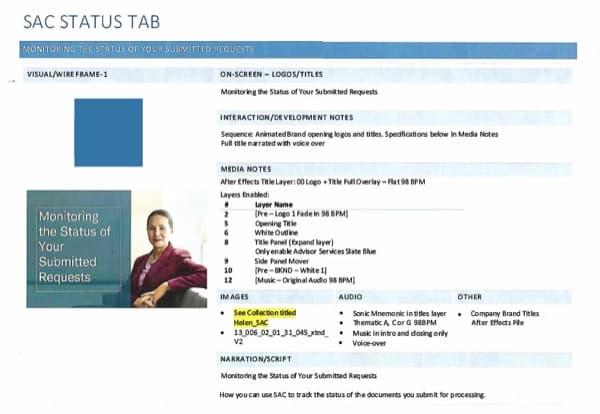
Storyboarding is vital in micro-learning production — acting as the visual plan that organizes content and interactions, aligns designers and stakeholders on objectives early, and streamlines development by reducing revisions downstream. The storyboard was where the learning intention became a production specification.
Caltech · Personal Production · Daily Practice · 2024–Present
The argument the work makes
Three new rings, and growing.
Three new rings: formal AI/ML practice at Caltech, two production sites built with AI as collaborator, a daily professional practice where the tool amplifies what I bring to it from every growth ring that came before.
The differentiator is what I bring to the tool, not what the tool can do on its own. Many people can use AI tools. Few bring what I call accumulated weirdness: that specific, unrepeatable combination of skills nobody planned for. In my case: print design and production, multimedia & motion design and production, web application design and development, enterprise learning platforms, and now AI/ML. Every ring is the lever. The tool amplifies what you bring to it.
[AI] is not going to replace me. It's going to get the best version of me — the one with paste-up wax and Lingo scripts and twenty years of learning technology and a Caltech AI/ML certificate and an apparently bottomless appetite for the next thing.— from “Another Ring on the Tree” · LinkedIn · February 2026My essay on what a long career across disciplines brings to a new tool. The title's metaphor: each discipline is another ring on the trunk, none replacing the ones before.
01Caltech AI/ML Practice
Caltech CTME's AI/ML Bootcamp ran June through December 2024. Five projects, real outcomes, deployed code, each with its own LinkedIn portfolio entry and media artifacts. The work doesn't prove I became technical from a standing start. It proves my accumulated weirdness produces results the curriculum alone can't.
The brief was generic prompt engineering: develop a series of prompts that would let an AI collaborator act as a virtual project management consultant. I narrowed the scope from broad methodologies and project domains to Agile + project planning, ran five interaction scenarios (Initiating a Project Plan, Defining Scope, Sprint Planning, Resource Allocation, Tracking Progress), collected user feedback via Google Forms, and refined the three scenarios that drew responses. I delivered a final prompt set with a level-of-understanding personalization parameter, and was recognized as top of cohort on the first project of the program. The same discipline carried through the four that came after.
Beyond the brief
This wasn't a project that ended with a prompt set. It was the first Caltech project, and the working principle it taught, that the tool amplifies what you bring to it, anchors me in my everyday use of AI.
The brief assigned the full class set (User, Learner, Instructor, Course, Enrollment, SLTech Backend) with required methods and an interactive user-input function. I delivered all six classes, twenty-six methods, and the working backend. I also delivered type hints, Google-style docstrings, and defensive guards on every mutation (established within the first day), a five-notebook architecture with cross-notebook imports via ipynb.fs.full.<Module> (an unusual pattern), and real-name test fixtures.
Beyond the brief
First Python project ever. The brief assigned the classes; the documentation and defensive guards are what make a hand-off possible without a tour from the original author. The Python was new. The discipline was already in my bones from twenty years of building systems.
The brief was a Seaborn dashboard for the head of Sales and Marketing: wrangling, descriptive stats, state-by-state revenue, demographic group breakdowns, daily / weekly / monthly / quarterly charts, a JupyterLab report. I delivered all of it. I also delivered a custom logo and four-hex brand palette for the fictional company, agile-style branches and story-level commits on a solo course exercise, and a stakeholder-voice readout after every code cell.
Beyond the brief
A clean dashboard answers one question. A dashboard with a brand identity, an audit trail, and stakeholder narration is something the head of Sales and Marketing can hand to the CFO, the comms team, or the next analyst. Without a translation layer.
The brief was cluster analysis on Spotify's Rolling Stones catalog: exploratory data analysis on eleven raw audio features, dimensionality reduction discussion, and clustering with a method of my choosing. I delivered K-means clustering at k=3 (selected via elbow plus silhouette), three labeled cohorts across 1,508 cleaned tracks. I also delivered engineered features named in fan/critic language (groovy_factor, raw_energy), a fifteen-color palette named for Rolling Stones albums, and a published mid-project retrospective documenting my own data-cleaning miss. The twelve-day arc from “data cleaning concluded” to “resolving data cleaning mistakes” sits in the git log.
Beyond the brief
A clustering output a non–data-science stakeholder can read at a glance, with the palette and fan-language features doing translation work, and an honest record of the project's own arc. The retrospective is the kind of audit trail that survives a handoff and earns trust the next time.
The brief was a recipe: a specific CNN architecture, then a transfer-learning model using MobileNetV2, both built to spec layer by layer, with exact splits, epochs, optimizer, and loss. The work was to execute it and compare the two. I executed both and ran the comparison. I also delivered a five-notebook architecture with a shared utility module, persisted artifacts between notebooks, per-class diagnostic prose, and stakeholder voice running across every notebook.
Beyond the brief
A model that lives in one notebook is a one-shot demonstration. The same model with persistence, per-class diagnostics, and stakeholder narration is a deliverable someone else can audit, present, or pick up three months later. Without a tour from the original author.
Two production sites, and the workflow they surfaced.
Two production websites built with AI as collaborator: my argument site, and my spouse's professional consulting site. The four-surface workflow that produced them is the genuine discovery, more than the sites are.
Personal Production · 2025–Present
jlampitt.com: the argument site
An argument site, not a portfolio. LinkedIn carries the career inventory; jlampitt.com makes the case that three growth rings (design, L&D, AI/ML) keep growing alongside each other, none replacing the ones before. Case studies are evidence cited in the argument.
Next.js 16 (App Router, TypeScript)
Tailwind v4
Vercel (edge cache, GitHub auto-deploy)
Mux (video playback)
Vercel Blob (PDF storage)
Personal Production · Active Client Site · 2025–Present
ann.piscitelli-lampitt.com: IP-protected client work
My spouse's professional consulting site. Her work product is the asset, so the site needs to demonstrate it without making it extractable. View-only by design.
Next.js 16 (App Router, TypeScript)
Tailwind v4
Vercel (edge cache, GitHub auto-deploy)
Mux (player-level downloads disabled)
Vercel Blob (PDF modals, no download)
The Workflow as a Designed Method
Four surfaces, choreographed.
Claude.ai
Strategic planning & creative iteration
Claude Cowork
Operational workflows
Claude Code in VSCode
Direct implementation
Project Knowledge
Institutional memory
Hover a surface to see what it produces.
03Daily Practice
Three citations, three kinds of work, one collaborator.
Three citations from my work at the city: three different kinds of work, all of them routed through AI as a daily collaborator. The work below is from my daily practice, not from any organizational AI strategy or governance role. Microsoft 365 Copilot is the sanctioned AI collaborator at work. Without it, none of this happens at scope. This is AI literacy in practice.
I inherited an IT training program that had been left practically abandoned for almost two years. I carry the program scope alone, save one part-time assistant. The program needed a credible offering across multiple Microsoft and Adobe tools, pitched to skeptical stakeholders, measured against an inherited baseline whose data didn't reconcile.
I run four concurrent learning pathways (M365 Foundation, Excel Mastery, SharePoint Progressive, Adobe Acrobat Essentials): 30 courses, 53 training sessions across 16 weeks of learning. Contract facilitators deliver; I supervise, run reports, and capture year-over-year outcomes in an Executive Impact Report. AI carries a parallel analytical track: drafts the impact report, frames program-management questions in natural language and iterates to clarity, produces semester-by-semester catalog recommendations. That parallel track is what makes the scope possible solo.
209%
Increase in employees trained, FY 2024–2025 over the inherited baseline
23%
Cost reduction, FY 2024–2025 over the inherited baseline
My accumulated weirdness shows up in the framing and the methodology. I designed the pathways under a “misunderstood or underused” framing rather than “new tools.”The reframe is what makes them defensible to skeptical stakeholders. I reconstructed the baseline from inconsistent historical data: the inherited invoice-log session counts didn't match the inherited class schedule, so I questioned the data and discarded prior fiscal years rather than averaging across them. I built a communications framework as a designed constraint, not a prompt.
Four concurrent pathways, designed under one framing
01M365 Foundation
02Excel Mastery
03SharePoint Progressive
04Adobe Acrobat Essentials
Framed as “misunderstood or underused” rather than “new tools.” The reframe is what made the pathways defensible to skeptical stakeholders.
The City Clerk's office had compliance training in the enterprise LMS, and it was failing learners. The original configuration crammed two long video recordings and a Final Assessment into a single four-hour course: fail the assessment, restart everything from the beginning. The build needed to dismantle that failure mode: break the source into modular courses, sequence them in the LMS, stand the Final Assessment up on its own. Source material: two two-hour Teams recordings, raw, no segmentation.
I delivered the full production pipeline, and AI was the partner at every step. The segmentation plan came out of AI-assisted analysis on the source recordings: topics identified, timestamps mapped, four hours of raw screen capture turned into a clean editing plan before Premiere ever opened. Adobe Premiere Pro and Media Encoder for the cuts, captions, and encoded exports, with AI catching the encoding-preset mismatch that dropped per-module footprint roughly eightfold. Fourteen three-slide Adobe Captivate modules wrapping the segmented videos, packaged as SCORM and organized as a Learning Plan in the enterprise LMS, built in a pilot-first sequence with AI helping interrogate SCORM attempt-state behavior at a level the documentation didn't reach. The Final Assessment built natively in the LMS: a 75-question pool, 10 questions per attempt, 80% to pass, three attempts.
My accumulated weirdness showed up in the small moments, the ones from twenty years of media craft:
A caption workflow that baked subtitles into the SCORM-packaged modules via Adobe Premiere and Media Encoder. Captivate's slide video media doesn't carry native captions, so accessibility had to be solved upstream.
A bitrate diagnosis dropping module footprint roughly eightfold (~219 MB to ~63 MB per ten-minute module) after catching that the encoding preset was set roughly ten times higher than the source needed.
A custom JavaScript timer to replace the playbar Adobe Captivate v13 had dropped. Without it, learners had no way to see how much of a module was left.
The SCORM “Never Send Resume Data” setting turned on as part of a deliberate restart-over-resume design choice. Engineering around the LMS's slide-level bookmark would have been complex, and load latency made “resume” look like “restart” to learners anyway. Better to choose restart cleanly and tell them about it.
A two-description architecture (admin-facing manifest descriptions vs. learner-facing catalog descriptions), kept as a working discipline, not a documentation exercise.
Key artifacts
14 Adobe Captivate modules (SCORM packaged) · enterprise LMS Learning Plan · LMS-native Final Assessment (75-question pool) · 2 two-hour Teams recordings with AI-assisted segmentation · Adobe Premiere + Media Encoder production pipeline · custom JS timer for Captivate v13 · Pillow-generated module covers and catalog cards · two-description architecture
A manager needed to know whether any of four constituent-engagement vendors overlapped with tools we already had, and whether any warranted a deeper look.
I delivered four platform evaluations in parallel, each rendered into the nine-section structure shown below, closed with a Summary Assessment Table and a non-optional Flags & Uncertainties section, the place where procurement risk lives. I designed a multi-chat project to hold the architecture (separate chats per platform, a synthesis hub, a skill-development thread) so the four evaluations could run at the same depth without losing context. AI carried the draft prose and the cross-evaluation consistency; I carried the judgment on every procurement-risk call.
The methodology, applied identically across four platforms
01Core Functionality
02Use Cases
03Ease of Use
04Data & Reporting
05Systems Integration
06Pricing
07WCAG / ADA Compliance
08Multilingual Support
09Notable Clients
My accumulated weirdness showed up in the methodology. I restricted sourcing to vendor websites only, a practical boundary that becamethe method: the quality of a vendor's own documentation became part of the evaluation. A platform that can't clearly disclose pricing, accessibility claims, or client references on its own website is a procurement risk, regardless of what a sales rep says later.
“Every single time, the people who thrived were the ones who saw the new thing as raw material, not a threat — the ones who brought everything they were to the new frontier and discovered that their accumulated weirdness was exactly what the moment needed.”— from “Another Ring on the Tree” · LinkedIn · February 2026From the section of the essay on technological inflection points: the pattern I've watched repeat across more than twenty-five years.
Five Caltech projects. Two production sites. A daily practice. AI is raw material now.